Commercial Concrete in New Orleans, LA
Commercial concrete in New Orleans covers parking lots, drive approaches, loading docks, warehouse slabs, and exterior flatwork for retail and industrial properties. A properly detailed commercial slab here requires 5 to 6 inches of 4000 PSI mix over a prepared subgrade, with reinforcement and drainage designed around the soft alluvial clay and high water table that underlie most of the metro area. This page explains scope, cost, sequence, and what differentiates a slab that holds from one that settles within five years.
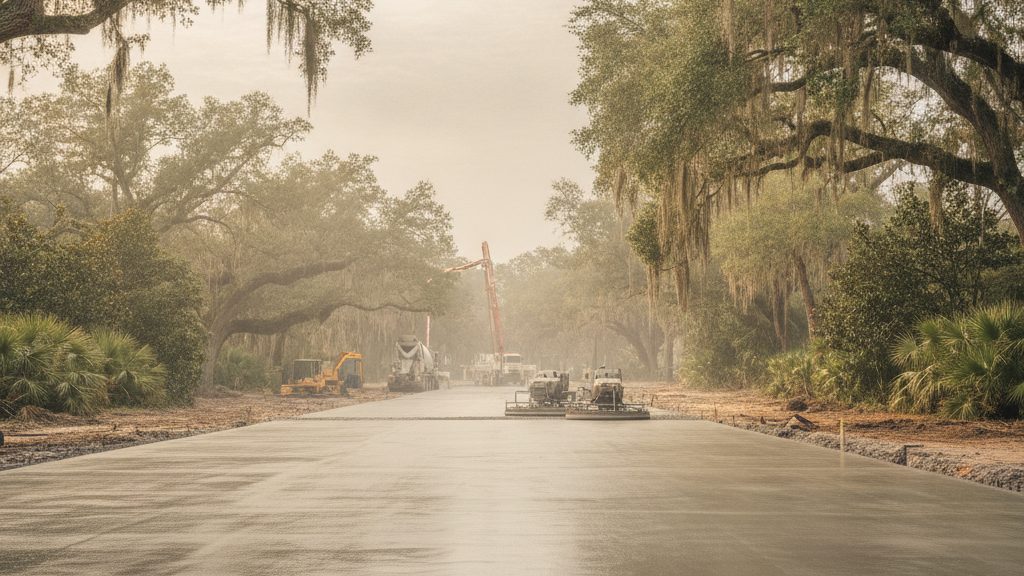
Key facts
- Commercial concrete slabs in New Orleans are poured at 5 to 6 inches thick for vehicle-rated applications.
- 2026 rates for commercial flatwork run $9 to $16 per square foot depending on thickness, reinforcement, and subgrade condition.
- A 10,000 sq ft parking lot replacement in the Greater New Orleans area runs $90,000 to $160,000 in 2026.
- Control joints are cut every 10 to 15 feet within 12 hours of the pour to prevent uncontrolled cracking.
- Full design strength is reached at 28 days. Vehicle traffic is permitted after 7 days.
What Does Commercial Concrete Work Cover in New Orleans?
Commercial concrete work in Greater New Orleans includes parking lots, loading dock aprons, drive approaches, warehouse and industrial floor slabs, concrete curbing, ADA-compliant flatwork, and exterior pads for mechanical equipment. A full commercial concrete project moves from site assessment and subgrade evaluation through demolition, excavation, forming, reinforcement placement, the pour itself, finishing, joint cutting, and final cure. Permit requirements vary by parish and project type. Confirm requirements with your specific parish permit office before work begins.
Commercial concrete work does not include structural concrete such as columns, beams, or elevated decks. Those require a licensed structural engineer and a separate scope. The flatwork scope described here is what a property manager or GC typically bids as a standalone line item in a site work package.
What Does Commercial Concrete Cost in New Orleans in 2026?
Commercial flatwork in New Orleans runs $9 to $16 per square foot in 2026, installed and finished. A 10,000 sq ft parking lot replacement falls between $90,000 and $160,000 depending on four variables.
| Variable | Lower end | Higher end |
|---|---|---|
| Slab thickness | 4 inches (pedestrian) | 6 inches (heavy truck) |
| Subgrade condition | Firm, minimal repair needed | Organic fill requiring excavation and replacement |
| Reinforcement | Fiber mesh only | #4 rebar on 18-inch centers |
| Demolition | No existing slab | Full removal of failed asphalt or concrete |
Smaller pad pours under 2,000 sq ft carry a higher per-square-foot rate because mobilization, forming, and finishing costs are spread over less area. A loading dock apron at 800 sq ft typically runs $11,200 to $14,400 in 2026.
How Is a Commercial Concrete Job Done, Step by Step?
A commercial concrete pour follows a fixed sequence. Skipping or compressing any step is where failures start.
Site Assessment and Bid Package Review
The first step is reviewing the bid package and walking the site to assess existing subgrade, drainage fall, and any buried utilities. A probe or test pit confirms whether organic material is present below grade. Organic fill cannot support a commercial slab and must be excavated.
Demolition and Excavation
Failed slabs or asphalt are broken out and hauled off. Excavation depth targets 10 to 12 inches below finished surface to allow for 4 to 6 inches of compacted base plus slab thickness.
Subgrade Preparation and Compaction
Clean limestone base is placed and compacted in 4-inch lifts to 95% standard Proctor density. A compaction test at this stage is standard on any commercial job. Skipping compaction testing is the single most common source of future settlement in New Orleans flatwork.
Forming and Reinforcement
Forms are set to grade with the drainage fall built in, a minimum of 1 inch per 10 feet away from structures. Reinforcement for vehicle-rated slabs is #4 rebar on 18-inch centers throughout, tied and chaired 2 inches off the subgrade. Fiber mesh alone does not meet load rating requirements for truck traffic.
Pour, Finish, and Joint Cutting
A 4000 PSI mix with a water-to-cement ratio below 0.50 is standard for commercial flatwork. The slab is struck off, bull-floated, and finished to the specified texture, broom finish for exterior, trowel finish for warehouse interiors. Control joints are saw-cut to one-quarter of the slab depth within 12 hours of the pour, spaced every 10 to 15 feet, to direct any shrinkage cracking to a predictable location.
What Do New Orleans Ground Conditions Change About This Work?
Greater New Orleans sits on soft alluvial clay and organic silt over a water table that sits within 2 to 4 feet of the surface across most of the south shore and west bank. That ground compresses under load and expands when saturated, which is why commercial slabs here settle at a rate that surprises property owners accustomed to work done in other regions.
Three adjustments are non-negotiable on most New Orleans commercial concrete projects. First, minimum slab thickness for any vehicle-rated application is 5 inches, and 6 inches is standard for heavy delivery traffic. Second, subgrade preparation must include removal of any organic material found below grade, not just surface vegetation. A 6-inch limestone base compacted to 95% density is the minimum before forming begins. Third, drainage fall must direct water away from the slab edge. Standing water at a slab edge accelerates subgrade erosion on clay soils. A phased pour on large lots allows each section to be properly screeded and drained before the adjacent section is placed.
Spec compliance on these three points is where commercial concrete in New Orleans diverges from standard flatwork specs written for better-draining soils elsewhere.
How Long Does a Commercial Concrete Job Take and When Can You Use It?
A 10,000 sq ft parking lot replacement runs 5 to 8 working days from demolition start to final joint sealing, weather permitting. Forming and reinforcement on a job that size typically requires 2 to 3 days. The pour itself is a single day. Joint cutting follows within 12 hours.
Use restrictions are determined by concrete strength gain, not calendar preference. Foot traffic is safe at 24 to 48 hours. Vehicle traffic is permitted at 7 days. Full design strength of 4000 PSI is reached at 28 days. Heavy loaded trucks should stay off the slab until the 28-day mark on any commercial job where load rating matters.
How Do You Tell Good Commercial Concrete Work from Bad?
A property manager or GC can check five things on any completed commercial concrete job without specialized equipment.
- Joint spacing: control joints appear every 10 to 15 feet in both directions. Larger panels indicate joints were skipped.
- Joint depth: a proper saw cut reaches one-quarter of the slab thickness. A shallow score line is not a control joint.
- Edge thickness: measure the slab at any exposed edge. A vehicle-rated slab reads 5 to 6 inches. A slab that measures 3.5 inches at the edge was under-formed or over-finished.
- Drainage fall: water should not pool on the surface 48 hours after rain. Ponding indicates a flat or reverse-pitched pour.
- Surface cracking at 30 days: hairline shrinkage cracks running to a joint are normal and expected. Random mid-panel cracks longer than 12 inches indicate joint spacing failures or inadequate subgrade compaction.
For a written estimate on a parking lot, loading area, warehouse slab, or any commercial flatwork in Greater New Orleans, contact New Orleans Concrete Contractors. Estimates are free and include a site visit and a written scope.
Common questions
- How much does a commercial parking lot cost in New Orleans?
- A commercial parking lot in New Orleans runs $9 to $16 per square foot in 2026. A 10,000 sq ft lot falls between $90,000 and $160,000 depending on slab thickness, subgrade condition, reinforcement type, and whether demolition of an existing surface is included in the scope.
- How thick does a commercial concrete slab need to be in New Orleans?
- A vehicle-rated commercial concrete slab in New Orleans requires a minimum of 5 inches, with 6 inches standard for heavy delivery truck traffic. Pedestrian-only flatwork can be poured at 4 inches, but any surface that takes forklift or truck loads needs the additional thickness and rebar reinforcement.
- Do I need a permit for commercial concrete work in New Orleans?
- Permit requirements for commercial concrete work vary by parish and project type. Some flatwork replacements are exempt while new construction and larger site work projects require review. Confirm the specific threshold and application process with your parish permit office before work begins.
- How long before trucks can use a new commercial concrete slab?
- Trucks can use a new commercial concrete slab after 7 days. Full design strength of 4000 PSI is not reached until 28 days, so heavy loaded vehicles should stay off the surface until that mark on any job where load rating is a factor. Foot traffic is safe at 24 to 48 hours.
- Why do commercial concrete slabs settle so fast in New Orleans?
- Commercial concrete slabs in New Orleans settle because the underlying soil is soft alluvial clay and organic silt that compresses under load and shifts when saturated. Slabs fail when organic material is left below grade or when limestone base is not compacted to 95% standard Proctor density before the pour.
- What is a phased pour and when is it used on commercial jobs?
- A phased pour divides a large commercial concrete placement into sections poured on separate days. Phased pours are used on lots over 5,000 sq ft to allow each section to be properly struck off, drained, and cured before adjacent sections are placed, which reduces the risk of settlement and cracking on unstable New Orleans subgrade.
Commercial Concrete by area
Metairie
Jefferson Parish
Kenner
Jefferson Parish
Gretna
Jefferson Parish
Harvey
Jefferson Parish
Marrero
Jefferson Parish
Westwego
Jefferson Parish
Harahan
Jefferson Parish
River Ridge
Jefferson Parish
Terrytown
Jefferson Parish
Chalmette
St. Bernard Parish
Arabi
St. Bernard Parish
Slidell
St. Tammany Parish
Mandeville
St. Tammany Parish
Covington
St. Tammany Parish
Destrehan
St. Charles Parish
Luling
St. Charles Parish
Belle Chasse
Plaquemines Parish
Last updated August 6, 2026
Get a free estimate
Tell us what you need and where. An estimator walks the site, measures, and leaves you a written number. The visit takes 20 to 30 minutes and costs nothing.
- Free on-site measurement and written estimate
- Serving New Orleans and surrounding parishes within 40 miles
- Residential and commercial work