Stamped & Decorped Concrete in New Orleans, LA
Stamped and decorative concrete covers patios, driveways, pool decks, and walkways with a textured, colored finish poured in place and sealed on-site. The work combines standard flatwork with pattern stamps, integral color or surface-applied color, release agent, and a protective sealer coat. Every stamped concrete job in New Orleans requires extra attention to subgrade preparation because the region's soft clay and high water table make slab settlement the most common failure mode.
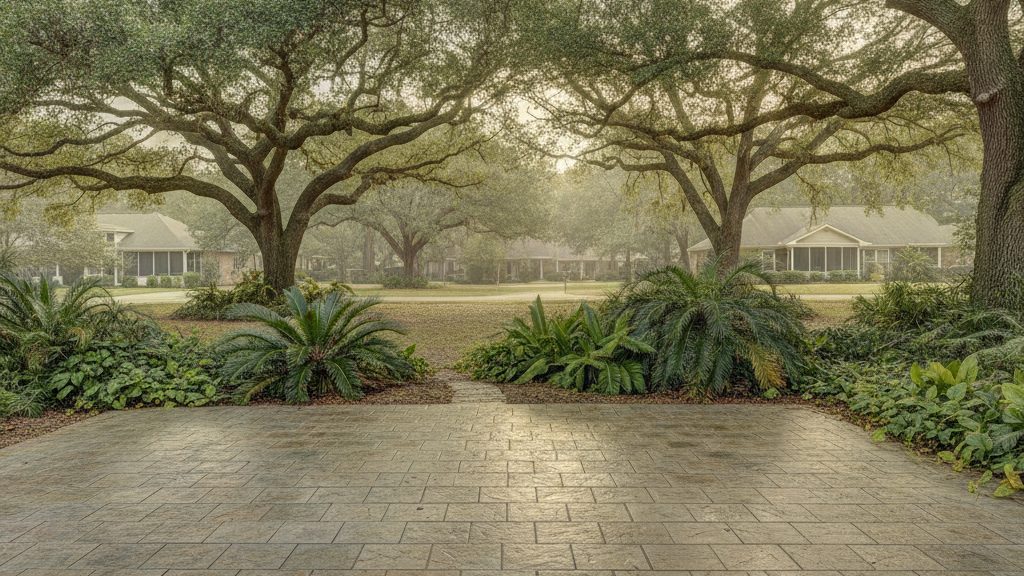
Key facts
- Stamped concrete costs $12 to $22 per square foot in Greater New Orleans in 2026, depending on pattern complexity and color treatment.
- A typical 400 square foot patio runs $4,800 to $8,800 installed, including subgrade prep, pour, stamp, and seal.
- Slabs in New Orleans are poured at 4 inches minimum, with many contractors specifying 5 inches over compacted base due to soft clay subgrade.
- Foot traffic is safe after 24 to 48 hours; vehicle traffic requires a full 7-day cure before use.
- Control joints are cut every 8 to 10 feet within 12 hours of the pour to manage cracking.
- A non-slip additive is mixed into the sealer coat, which is required on wet-climate surfaces with stamped texture.
What Stamped and Decorative Concrete Work Covers in New Orleans
Stamped and decorative concrete in New Orleans includes new patio slabs, driveway replacements, pool decks, front walkways, and outdoor entertainment surfaces. The work does not include structural floors, elevated slabs, or vertical surfaces. A typical job runs from an initial site assessment through demolition of any existing concrete, subgrade excavation and compaction, forming, reinforcement placement, the pour itself, stamp mat application, color application, joint cutting, and a final sealer coat. Each step affects the finished appearance and the long-term performance of the slab.
Color is introduced in two ways. Integral color is added to the mix before the pour and produces color throughout the full 4-inch slab depth. A surface-applied release agent is dusted or sprayed onto the wet surface before stamping and creates a two-tone contrast by tinting the high points of the pattern differently from the recesses. Many jobs use both methods together. The stamp mat is pressed into the concrete while the surface is still plastic, typically within 1 to 3 hours of the pour depending on ambient temperature and humidity.
Ashlar slate is the most requested pattern in Greater New Orleans because the large rectangular format suits both traditional and contemporary homes. Running bond brick, cobblestone, and wood plank patterns are also common. The sealer coat, applied after a minimum 28-day cure on new slabs, locks in color and provides a moisture barrier. An anti-slip additive is mixed into the sealer before application on any stamped concrete surface, since the textured profile can become slick when wet.
What Does Stamped Concrete Cost in New Orleans in 2026?
Stamped and decorative concrete in New Orleans runs $12 to $22 per square foot installed in 2026, which puts a 400 square foot patio between $4,800 and $8,800 and a 600 square foot driveway between $7,200 and $13,200. Four variables move the number most.
Pattern complexity is the first. A single-color ashlar slate stamp sits at the lower end of the range. A multi-color design using integral color, two release agent tones, and a detailed border pattern pushes toward the upper end. Demolition of an existing slab adds $1.50 to $3.00 per square foot depending on slab thickness and access. Subgrade repair, which is common in Orleans and Jefferson parishes where fill consolidates under older slabs, adds $2.00 to $5.00 per square foot when re-compaction and base material are needed. Sealer recoating every 2 to 3 years is an ongoing maintenance cost, typically $0.75 to $1.50 per square foot for a contractor-applied recoat.
How Is a Stamped Concrete Job Done Step by Step?
A stamped concrete job in New Orleans follows eight steps, each with a specific spec that affects the finished result. First, the contractor assesses the site, checks existing drainage, and marks any underground utilities. Second, existing concrete is removed and hauled off. Third, the subgrade is excavated to the required depth, typically 8 to 10 inches below finish grade to allow for base and slab thickness. Fourth, 4 inches of crushed limestone base is spread and compacted in 2-inch lifts with a plate compactor. Fifth, 6-mil poly sheeting is laid as a vapor barrier. Sixth, 3,500 PSI concrete is poured at 4 to 5 inches thick, with 3/8-inch rebar placed on 18-inch centers for residential work. Seventh, the stamp mat is pressed into the surface in overlapping passes before the concrete stiffens. Eighth, control joints are cut to one-quarter of the slab depth, every 8 to 10 feet, within 12 hours of the pour. The sealer coat is applied after full 28-day cure.
What Do New Orleans Ground Conditions Change About This Work?
Greater New Orleans sits on soft alluvial clay and organic silt with a water table that can sit within 2 feet of the surface, which changes stamped concrete work in four specific ways. Subgrade preparation takes longer here than in most markets. Clay compacts poorly at high moisture content, so contractors often need to over-excavate by 2 to 4 inches and replace the native material with imported crushed limestone before any compaction begins. Skipping this step is the most common cause of slab settlement and cracking in Jefferson and Orleans parishes.
Slab thickness is increased to 5 inches in many residential applications here, compared to the 4-inch standard used in areas with stable sandy subgrade like the north shore of Lake Pontchartrain. The additional thickness adds roughly $0.80 to $1.20 per square foot but significantly reduces the risk of cracking under differential settlement. Drainage fall is also critical. Stamped concrete on the south shore must drain away from the structure at a minimum 2 percent slope, which equals a 1/4-inch drop per foot, because standing water under a slab accelerates clay softening. Rebar reinforcement is standard on all stamped slabs in this region; wire mesh alone is not adequate over soft fill.
How Long Does a Stamped Concrete Job Take and When Can You Use It?
A standard residential stamped concrete patio of 400 to 600 square feet takes 2 to 4 days from demolition through the pour, not including cure time. Day one covers demolition and subgrade prep. Day two covers forming, rebar, and the pour. Day three is used for joint cutting and any cleanup. The decorative sealer is applied after 28 days. Foot traffic is safe at 24 to 48 hours after the pour. Vehicle traffic requires a full 7 days of cure. Full design strength reaches 3,500 PSI at 28 days, which is when the sealer coat is applied. Applying sealer before 28 days traps moisture in the slab and causes adhesion failure and color inconsistency.
How Do You Tell Good Stamped Concrete Work from Bad?
A homeowner can inspect stamped concrete work against five checkable criteria before signing off. First, measure control joint spacing: joints should appear every 8 to 10 feet in both directions. Second, check joint depth at an edge: a proper joint reaches at least one-quarter of the slab thickness, which is 1 inch on a 4-inch slab. Third, look at the slab edge profile, which reveals actual poured thickness. A clean 4-inch edge is visible where the slab meets a form or expansion joint. Fourth, check drainage fall with a level: water should sheet off the surface and not pool at any low point. Fifth, run your palm across the sealer surface in a shaded area after a rain. A gritty texture confirms the anti-slip additive is present. A surface that feels polished and smooth is a sealer applied without the additive.
Contact New Orleans Concrete Contractors for a free on-site estimate. A crew member will assess the subgrade condition, measure the area, and walk through pattern and color options before any number is discussed.
Common questions
- How much does stamped concrete cost per square foot in New Orleans?
- Stamped concrete in New Orleans costs $12 to $22 per square foot installed in 2026. A 400 square foot patio runs $4,800 to $8,800 depending on pattern complexity, color treatment, demolition of existing concrete, and whether the subgrade requires imported base material due to soft clay conditions.
- How long before I can walk on a stamped concrete patio?
- Foot traffic is safe on stamped concrete after 24 to 48 hours. Vehicle traffic requires a 7-day cure. The sealer coat is not applied until 28 days after the pour, because applying sealer earlier traps moisture in the slab and causes adhesion failure and color problems.
- Why does stamped concrete crack in New Orleans?
- Stamped concrete cracks in New Orleans most often because the native soft clay subgrade was not replaced with compacted limestone before the pour. Clay consolidates under load and causes differential settlement. Control joints cut to one-quarter slab depth every 8 to 10 feet manage expected shrinkage cracking when subgrade prep is done correctly.
- What is a release agent and does every stamped concrete job need one?
- A release agent is a powder or liquid applied to the wet concrete surface before the stamp mat is pressed in. Release agent prevents the stamp mat from sticking and adds a contrasting tone to the high points of the pattern. Most stamped concrete jobs use a release agent to create the two-tone color depth that makes patterns look realistic.
- Do I need a permit for a stamped concrete patio in New Orleans?
- Permit requirements for residential concrete flatwork vary by parish. Some parishes require a permit for any new impervious surface above a minimum square footage; others do not. Confirm the current threshold and fee with your parish permit office before work begins, since requirements change and vary between Orleans, Jefferson, and St. Tammany parishes.
- How often does stamped concrete need to be resealed?
- Stamped concrete in Greater New Orleans needs resealing every 2 to 3 years because heat, UV exposure, and high humidity degrade the sealer coat faster than in cooler climates. A contractor-applied recoat runs $0.75 to $1.50 per square foot. Resealing on schedule preserves color and prevents moisture from penetrating the slab surface.
Stamped & Decorative Concrete by area
Stamped & Decorative Concrete in Metairie
Jefferson Parish
Stamped & Decorative Concrete in Kenner
Jefferson Parish
Stamped & Decorative Concrete in Gretna
Jefferson Parish
Stamped & Decorative Concrete in Harvey
Jefferson Parish
Marrero
Jefferson Parish
Westwego
Jefferson Parish
Harahan
Jefferson Parish
River Ridge
Jefferson Parish
Terrytown
Jefferson Parish
Stamped & Decorative Concrete in Chalmette
St. Bernard Parish
Arabi
St. Bernard Parish
Stamped & Decorative Concrete in Slidell
St. Tammany Parish
Stamped & Decorative Concrete in Mandeville
St. Tammany Parish
Stamped & Decorative Concrete in Covington
St. Tammany Parish
Destrehan
St. Charles Parish
Luling
St. Charles Parish
Belle Chasse
Plaquemines Parish
Last updated August 6, 2026
Get a free estimate
Tell us what you need and where. An estimator walks the site, measures, and leaves you a written number. The visit takes 20 to 30 minutes and costs nothing.
- Free on-site measurement and written estimate
- Serving New Orleans and surrounding parishes within 40 miles
- Residential and commercial work