Foundations & Slab-on-Grade in New Orleans, LA
Foundations and slab-on-grade construction in New Orleans requires soil-specific engineering that standard slab specs do not address. Greater New Orleans sits on soft alluvial clay with a high water table, and a slab poured without accounting for that ground settles, cracks, and fails. New Orleans Concrete Contractors builds foundations and slabs for commercial, residential, and industrial properties across the Greater New Orleans area and surrounding parishes within 40 miles.
Key facts
- Residential slabs pour at 4 to 6 inches thick over a minimum 4-inch compacted granular base
- 2026 slab-on-grade costs range from $8 to $16 per square foot depending on thickness, reinforcement, and subgrade conditions
- Post-tension cable systems require a minimum slab thickness of 5 inches in Greater New Orleans clay soils
- Control joints cut to one-quarter slab depth within 12 hours of the pour, spaced every 10 feet
- Full design strength reaches 3,500 PSI or higher at 28 days; vehicle traffic begins at 7 days
What Does Foundations and Slab-on-Grade Work Cover in New Orleans?
Foundations and slab-on-grade construction covers the concrete structural base that supports a building or paved surface directly on prepared ground. The scope includes grade beams, pile caps, monolithic slabs, post-tension slabs, and thickened-edge slabs. A typical engagement starts with a site visit and review of the geotechnical soil report, then moves through excavation or demolition, subgrade preparation, forming, reinforcement placement, the concrete pour, finishing, joint cutting, and a monitored cure period.
Foundations and slab-on-grade work does not include structural framing, waterproofing membranes above slab level, or interior flooring finishes. Permit requirements vary by parish. Confirm applicable requirements with your parish permit office before breaking ground.
What Does a Foundation or Slab-on-Grade Cost in New Orleans in 2026?
Slab-on-grade construction in Greater New Orleans runs $8 to $16 per square foot in 2026, installed. A 2,000-square-foot commercial slab lands between $16,000 and $32,000 depending on four variables. First, slab thickness: a 4-inch residential slab costs less than a 6-inch post-tension commercial slab. Second, subgrade conditions: organic fill or loose soil requires additional excavation and imported base material at $3 to $6 per square foot added. Third, reinforcement type: rebar grids cost less than post-tension cable systems, which require a licensed post-tension installer and add $1.50 to $3.00 per square foot. Fourth, footing depth and grade beam requirements: deeper footings and continuous grade beams add forming labor and concrete volume. Grade beam and pile cap work is priced separately at $60 to $120 per linear foot depending on depth and cross-section.
How Is a Foundation or Slab-on-Grade Built Step by Step?
Foundations and slab-on-grade construction follows a fixed sequence. Each step affects the step that follows.
Site Assessment and Soil Report Review
Every foundations and slab-on-grade project begins with reviewing a geotechnical soil report that identifies bearing capacity, water table depth, and soil classification. A soil report determines footing depth, required base thickness, and whether the design calls for post-tension or conventional rebar. Sites without a current soil report require one before design begins.
Excavation and Subgrade Preparation
Excavation removes organic material and loose soil to reach a stable bearing layer. In most Greater New Orleans locations, that means removing 12 to 24 inches of native material. A minimum 4-inch layer of crushed limestone or recycled concrete base is placed and compacted to 95 percent Proctor density. Compaction is verified with a nuclear density gauge reading before forming begins.
Forming and Reinforcement
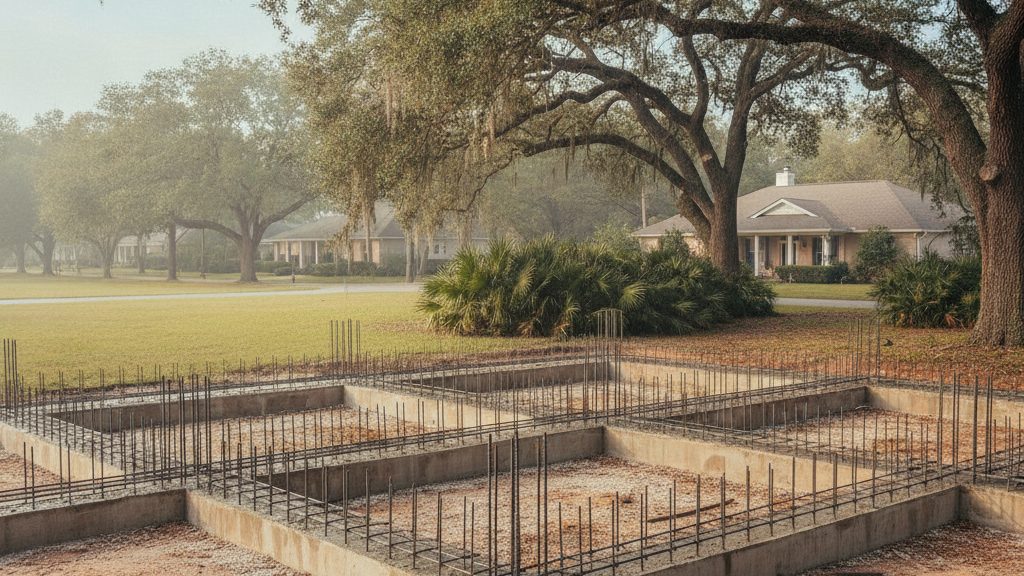
Forms set the slab perimeter and any thickened edges or grade beams. Conventional slabs receive a #4 rebar grid at 18-inch centers on 2-inch chairs to maintain cover. Post-tension slabs receive unbonded monostrand cables at 48-inch centers in each direction, stressed to 33,000 pounds per cable after the concrete reaches 2,500 PSI, typically 3 to 5 days after the pour. A 6-mil polyethylene vapor barrier runs under all slabs to limit moisture transmission from the water table.
Pour, Finish, and Joint Cutting
Concrete places at 3,500 PSI minimum for residential slabs and 4,000 PSI or higher for commercial foundations. Slump is verified at the truck before discharge. Finishing produces a broom texture for exterior slabs or a steel-trowel finish for interior warehouse and commercial floors. Control joints cut to one-quarter slab depth, no shallower than 1 inch, within 12 hours of the pour, spaced every 10 feet in each direction.
What Do New Orleans Ground Conditions Change About This Work?
Greater New Orleans sits on soft alluvial clay and organic silt over a water table that often runs within 2 to 4 feet of grade. That soil has low bearing capacity, high plasticity, and compresses under load over time, which is why foundations and slabs here settle in ways that identical designs do not in other regions.
Foundations and slab-on-grade construction in New Orleans addresses those conditions directly. Footing depth must reach below the active zone of expansive clay, which typically means 18 to 36 inches below finished grade depending on the soil report. Slabs over poor subgrade specify 5 to 6 inches of thickness rather than the 4-inch standard used in stable soils. Post-tension systems are common in Greater New Orleans commercial work because post-tension slabs tolerate differential settlement better than conventional rebar slabs. Drainage fall of 1 to 2 percent away from the structure is built into every exterior slab to prevent water from pooling against the foundation and saturating the subgrade further. On sites where the soil report identifies bearing capacity below 1,500 pounds per square foot, grade beams or pile caps transfer load to deeper, more stable soil rather than relying on surface bearing.
How Long Does Foundations and Slab-on-Grade Work Take?
A standard 2,000-square-foot slab-on-grade takes 3 to 5 working days from excavation to finished pour, not counting cure time. Grade beam and pile cap work adds 2 to 4 days depending on depth and forming complexity. Foot traffic on a finished slab is safe at 24 to 48 hours. Vehicle traffic begins at 7 days. Full design strength, 3,500 PSI or higher, reaches at 28 days. Post-tension cables are stressed at 3 to 5 days and the slab carries design load at 28 days.
How Do You Tell a Well-Built Slab from a Poor One?
A property manager or GC can inspect six things without special equipment. First, measure joint spacing: control joints appear every 10 feet, not every 15 or 20. Second, check joint depth with a key or thin blade: a proper joint reaches one-quarter of slab thickness, at least 1 inch on a 4-inch slab. Third, look at the slab edge: a consistent 4-inch edge thickness with no taper indicates forms were set correctly. Fourth, confirm drainage fall: water should sheet away from the structure, not pool at the edge. Fifth, check the perimeter for honeycombing, which shows as voids or rough aggregate exposed along the edge, a sign of improper consolidation. Sixth, on a post-tension slab, verify that cable end caps are in place and the post-tension log documents stressing loads and dates.
New Orleans Concrete Contractors provides free on-site estimates for foundations and slab-on-grade projects across Greater New Orleans and surrounding parishes. Contact the office to schedule a site visit and receive a written, itemized proposal.
Common questions
- How thick should a concrete slab be in New Orleans?
- A residential slab in New Orleans pours at 4 to 6 inches thick depending on load and subgrade conditions. Commercial slabs typically specify 5 to 6 inches. Soft clay soils in Greater New Orleans often require the thicker end of that range, and a geotechnical soil report confirms the minimum thickness for any specific site.
- What is a post-tension slab and do I need one?
- A post-tension slab uses high-strength steel cables stressed to approximately 33,000 pounds each after the concrete sets, which puts the slab in compression and resists cracking from differential settlement. Post-tension slabs are common in Greater New Orleans commercial construction because the soft clay subgrade causes more settlement movement than conventional rebar slabs can tolerate without cracking.
- Do I need a soil report before pouring a foundation in New Orleans?
- A soil report is required before designing any commercial foundation and is strongly recommended for residential slabs in Greater New Orleans. The report identifies bearing capacity, water table depth, and soil classification. Without those values, footing depth and reinforcement design are guesses. A basic geotechnical report for a residential site typically costs $800 to $2,500.
- How long before I can drive on a new concrete slab?
- Vehicle traffic on a new concrete slab starts at 7 days after the pour. Foot traffic is safe at 24 to 48 hours. The slab reaches full design strength at 28 days. Loading a slab heavily before 7 days risks surface damage and cracking, even if the concrete feels hard.
- What causes concrete slabs to settle in New Orleans?
- Slab settlement in Greater New Orleans comes from the soft alluvial clay and organic silt that make up most of the south shore subgrade. This material compresses under sustained load and loses support when it dries and rewets through seasonal cycles. Proper subgrade preparation, adequate base thickness, and post-tension reinforcement reduce settlement but do not eliminate it entirely on poor-bearing soils.
- What does a grade beam do in a slab foundation?
- A grade beam is a continuous reinforced concrete beam poured at or below grade around the slab perimeter or at interior load-bearing lines. A grade beam transfers building loads down to deeper, stable soil rather than relying on the surface bearing capacity of soft clay. Grade beam depth in Greater New Orleans typically runs 18 to 36 inches depending on the soil report findings.
Foundations & Slab-on-Grade by area
Metairie
Jefferson Parish
Kenner
Jefferson Parish
Gretna
Jefferson Parish
Harvey
Jefferson Parish
Marrero
Jefferson Parish
Westwego
Jefferson Parish
Harahan
Jefferson Parish
River Ridge
Jefferson Parish
Terrytown
Jefferson Parish
Chalmette
St. Bernard Parish
Arabi
St. Bernard Parish
Slidell
St. Tammany Parish
Mandeville
St. Tammany Parish
Covington
St. Tammany Parish
Destrehan
St. Charles Parish
Luling
St. Charles Parish
Belle Chasse
Plaquemines Parish
Last updated August 6, 2026
Get a free estimate
Tell us what you need and where. An estimator walks the site, measures, and leaves you a written number. The visit takes 20 to 30 minutes and costs nothing.
- Free on-site measurement and written estimate
- Serving New Orleans and surrounding parishes within 40 miles
- Residential and commercial work