Concrete Driveways in New Orleans, LA
A concrete driveway in New Orleans requires heavier subgrade preparation and reinforcement than in most other regions because the underlying clay and silt compress over time, which is what causes slabs to settle and crack. New Orleans Concrete Contractors installs and replaces residential concrete driveways across Greater New Orleans and the surrounding parishes, pouring 4-inch 3500 PSI slabs over compacted subgrade with rebar, proper joint layout and a broom finish built to hold up in this soil. Every project runs from site assessment through final cure with no subcontracted labor on the slab work.
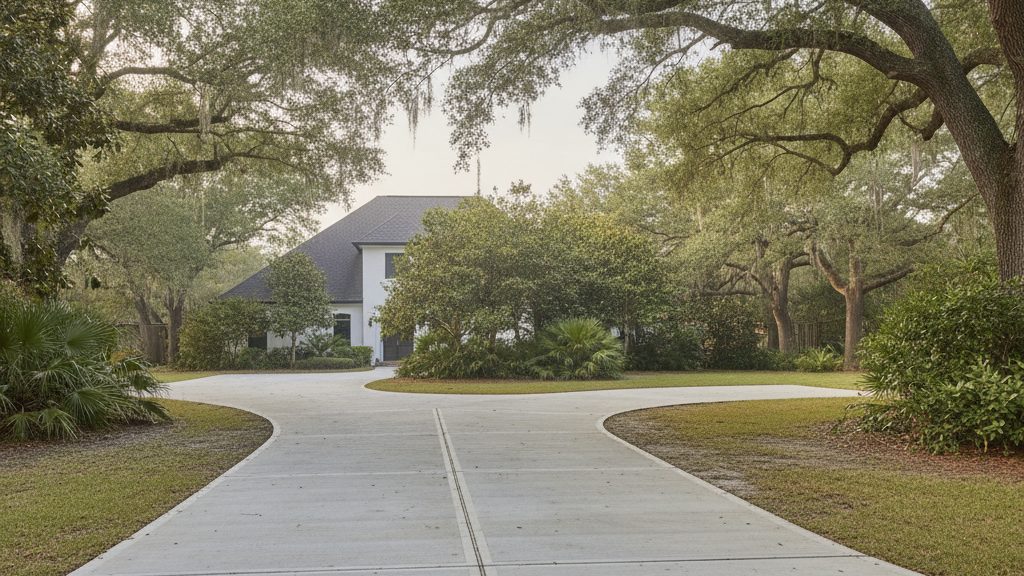
Key facts
- Residential concrete driveways in Greater New Orleans are poured at 4 inches thick over a minimum 4-inch compacted limestone base.
- Standard mix is 3500 PSI with #3 rebar on 18-inch centers or 6x6 wire mesh for residential loads.
- Control joints are cut every 8 to 10 feet within 12 hours of the pour to manage cracking.
- A typical 400 to 600 square foot driveway replacement runs $5,800 to $10,200 in 2026, depending on demolition, subgrade repair and finish.
- Vehicle traffic is safe at 7 days. Full design strength reaches 28 days after the pour.
What Concrete Driveway Work Covers in New Orleans
A concrete driveway project here covers every stage from the first site visit to the finished slab. That means assessing the existing surface or ground, removing any old concrete, excavating and compacting the subgrade, setting forms, placing reinforcement, pouring and finishing the concrete, cutting control joints and protecting the slab through the cure period.
The concrete apron at the garage transition is included in every driveway replacement. Apron work is not a separate line item because separating the apron from the main slab creates a cold joint that becomes a settlement point over time.
What concrete driveway work does not include: decorative overlays, pavers, asphalt, or plumbing and drainage modifications that require a licensed plumber. If permits are required for your project, requirements vary by parish, and the homeowner should confirm thresholds and fees directly with their parish permit office before work begins.
What Does a Concrete Driveway Cost in New Orleans?
A standard residential concrete driveway replacement in Greater New Orleans runs $14 to $22 per square foot in 2026, installed. A 400 square foot driveway falls in the range of $5,600 to $8,800. A 600 square foot driveway runs $8,400 to $13,200. Four variables move the number.
Demolition and haul-off of the existing slab adds $1.50 to $3.00 per square foot depending on slab thickness and access. Subgrade repair, meaning the removal of unstable fill and replacement with compacted limestone, adds $2.00 to $5.00 per square foot when the bearing material beneath the old slab has consolidated or failed. Finish selection affects price: a standard broom finish is included in the base rate, while an exposed aggregate or brushed pattern adds $2 to $4 per square foot. Reinforcement specification also shifts cost when the load requirement calls for #4 rebar rather than standard #3 rebar or 6x6 wire mesh.
How Is a Concrete Driveway Installed, Step by Step?
A concrete driveway installation follows a fixed sequence. Each step has a spec that determines whether the finished slab holds up.
Assessment: The existing surface or subgrade is evaluated for bearing capacity, drainage fall and apron condition. Low spots that hold water are flagged before excavation begins.
Demolition and excavation: Existing concrete is broken out and removed. The subgrade is excavated to a depth that allows for 4 inches of compacted limestone base plus 4 inches of concrete slab.
Subgrade preparation: Limestone base material is placed in lifts and compacted to 95 percent of standard proctor density. A 6-mil polyethylene vapor barrier is placed over the compacted base before reinforcement is set.
Forming and reinforcement: Forms are set to hold a consistent 4-inch slab depth at every edge. #3 rebar on 18-inch centers or 6x6 welded wire mesh is placed on chairs at the mid-depth of the slab, not on the ground.
Pour and finish: 3500 PSI concrete is placed, screeded and floated. A broom finish is applied before the surface sets, creating a texture that holds traction when wet.
Control joints: Joints are saw-cut to one-quarter of the slab depth, typically 1 inch deep on a 4-inch slab, every 8 to 10 feet in both directions. Joints are cut within 12 hours of the pour to get ahead of random cracking.
Cure: A curing compound is applied to retain moisture. The slab cures under controlled conditions for the full required period.
What Do New Orleans Ground Conditions Change About Concrete Driveway Work?
Greater New Orleans sits on soft alluvial clay and organic silt with a high water table, often within 2 to 4 feet of the surface. This soil compresses under load and expands when wet, which is the primary cause of driveway settlement and cracking in this region.
That ground condition changes three things about how concrete driveways are built here. First, subgrade preparation is more involved than in a region with stable sandy soil. Organic material and soft clay must be removed down to competent bearing material before the limestone base goes in. A 4-inch compacted limestone layer over unimproved clay is not sufficient. Where the native material is especially soft, a 6-inch limestone base is used instead.
Second, the vapor barrier is not optional here. The high water table means moisture migrates upward through the slab continuously. A 6-mil poly barrier beneath the slab reduces moisture transmission and limits the cycle of wetting and drying that causes surface scaling.
Third, drainage fall is set at a minimum of 1 inch of drop per 8 feet of run, directed away from the structure. In low-lying areas of Orleans, Jefferson and St. Bernard Parish, where positive drainage is harder to achieve, this sometimes requires raising the slab elevation at the apron.
How Long Does a Concrete Driveway Take, and When Can You Use It?
A standard residential concrete driveway replacement takes 2 to 4 days of active work. Day one is demolition and subgrade preparation. Day two is forming, reinforcement and the pour. Joint cutting happens the same day or early the following morning. After the pour, the use timeline is fixed by the chemistry of the concrete, not by schedule.
Foot traffic is safe at 24 to 48 hours after the pour. Passenger vehicles can use the driveway at 7 days. The concrete driveway reaches its full 3500 PSI design strength at 28 days. Heavy vehicle loads, including moving trucks or dumpsters, should not sit on a residential concrete driveway until the 28-day mark.
How Do You Tell a Good Concrete Driveway from a Bad One?
A homeowner can check six things on any finished concrete driveway without special tools.
Control joint spacing: joints should appear every 8 to 10 feet. A 500 square foot driveway with only 2 joints, or with no joints at all, will crack randomly within the first year.
Joint depth: a properly cut control joint is one-quarter of the slab depth. On a 4-inch slab that is 1 inch. A shallow scratch in the surface is not a control joint.
Edge thickness: look at the slab edge at the street or along a garden border. A 4-inch slab has a 4-inch edge. An edge that tapers to 2 inches is a feathered edge and will chip and crack under vehicle tire loads.
Drainage fall: pour a cup of water at the high end of the driveway. It should reach the street within 30 seconds on a properly sloped surface. Standing water on a new concrete driveway within the first week indicates a drainage problem.
Surface finish consistency: a broom finish should be uniform. Burn marks, trowel swirls and soft spots where the surface dusts off underfoot indicate finishing problems that affect long-term surface durability.
Apron transition: the concrete apron at the garage should be flush with or within one-quarter inch of the garage floor. A gap or lip at the apron is a settlement point and a trip hazard.
Contact New Orleans Concrete Contractors for a free on-site estimate. A crew member will assess the subgrade, measure the area and provide a written range before any work is scheduled.
Common questions
- How much does a concrete driveway cost in New Orleans?
- A residential concrete driveway in Greater New Orleans runs $14 to $22 per square foot installed in 2026. A 400 square foot driveway costs $5,600 to $8,800. A 600 square foot driveway runs $8,400 to $13,200. Demolition, subgrade repair and finish selection are the main variables that move the price up or down.
- How thick should a concrete driveway be in New Orleans?
- A residential concrete driveway in New Orleans should be poured at 4 inches thick over a 4 to 6 inch compacted limestone base. The soft clay and silt beneath most Greater New Orleans properties requires a thicker, well-compacted base than stable-soil regions to prevent settlement. Skipping subgrade preparation is the most common cause of driveway failure here.
- How long before I can drive on a new concrete driveway?
- Passenger vehicles can use a new concrete driveway at 7 days after the pour. Foot traffic is safe at 24 to 48 hours. The concrete driveway reaches full 3500 PSI design strength at 28 days. Heavy loads such as moving trucks should wait until the 28-day mark to avoid surface damage.
- Do concrete driveways in New Orleans need rebar?
- Yes. A concrete driveway in New Orleans requires either #3 rebar on 18-inch centers or 6x6 welded wire mesh placed at mid-depth of the slab. The high water table and expansive clay soil create ground movement that unreinforced concrete cannot accommodate. Reinforcement keeps the slab together if the subgrade shifts.
- Why do concrete driveways crack and settle in New Orleans?
- Concrete driveways in New Orleans crack and settle primarily because the underlying alluvial clay and organic silt compress under load and swell when wet. Without proper subgrade removal and 4 to 6 inches of compacted limestone base, the slab has no stable bearing surface. Inadequate control joints also allow uncontrolled cracking within the first 1 to 2 years.
- Do I need a permit for a concrete driveway in New Orleans?
- Permit requirements for concrete driveway work vary by parish in Greater New Orleans. Some parishes require a permit for full replacement, others do not. Homeowners should confirm current thresholds, fees and setback requirements directly with their parish permit office before work begins, as these rules change and vary between Jefferson, Orleans and St. Bernard Parish.
Concrete Driveways by area
Concrete Driveways in Metairie
Jefferson Parish
Concrete Driveways in Kenner
Jefferson Parish
Concrete Driveways in Gretna
Jefferson Parish
Concrete Driveways in Harvey
Jefferson Parish
Marrero
Jefferson Parish
Westwego
Jefferson Parish
Harahan
Jefferson Parish
River Ridge
Jefferson Parish
Terrytown
Jefferson Parish
Concrete Driveways in Chalmette
St. Bernard Parish
Arabi
St. Bernard Parish
Concrete Driveways in Slidell
St. Tammany Parish
Concrete Driveways in Mandeville
St. Tammany Parish
Concrete Driveways in Covington
St. Tammany Parish
Destrehan
St. Charles Parish
Luling
St. Charles Parish
Belle Chasse
Plaquemines Parish
Last updated August 6, 2026
Get a free estimate
Tell us what you need and where. An estimator walks the site, measures, and leaves you a written number. The visit takes 20 to 30 minutes and costs nothing.
- Free on-site measurement and written estimate
- Serving New Orleans and surrounding parishes within 40 miles
- Residential and commercial work