Concrete Slabs in New Orleans, LA
Concrete slab work in New Orleans covers the full scope from subgrade excavation to finished surface, including all forming, reinforcement, vapor barrier placement, pour, and joint cutting. A properly detailed slab on Greater New Orleans soil requires more subgrade preparation than most other regions because the underlying alluvial clay compresses and shifts under load. Every concrete slab job begins with an on-site assessment of existing ground conditions before any price or schedule is confirmed.
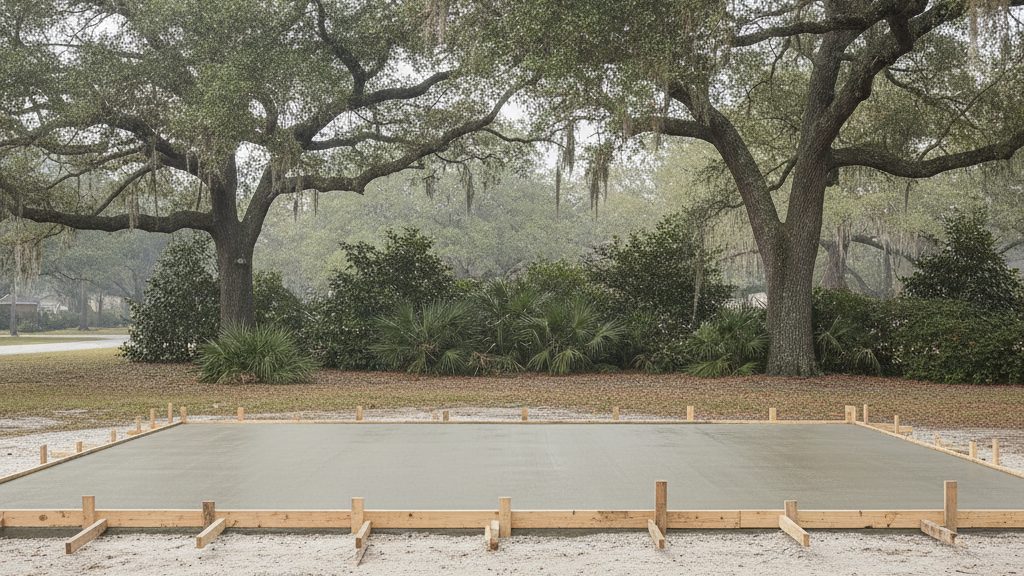
Key facts
- Residential concrete slabs are poured at 4 to 6 inches thick depending on load
- Standard mix for slabs in Greater New Orleans is 4000 PSI concrete
- A 6-mil poly vapor barrier is placed under every interior slab
- Control joints are cut every 8 to 10 feet within 12 hours of the pour
- Vehicle traffic is safe after 7 days; full design strength is reached at 28 days
- 2026 slab installation in New Orleans runs $6 to $14 per square foot depending on thickness, reinforcement, and subgrade conditions
What Concrete Slabs Work Covers in New Orleans
Concrete slab installation includes site assessment, excavation or demolition of existing material, subgrade preparation and compaction, vapor barrier installation, forming, steel reinforcement placement, the concrete pour, surface finishing, control joint cutting, and cure management. Work does not include landscaping, backfill beyond the immediate slab perimeter, or utility relocation. Permit requirements vary by parish and project type. Confirm current requirements with your parish permit office before work begins.
A typical residential concrete slab job in New Orleans runs 2 to 4 days on site for pours up to 1,000 square feet. Larger commercial concrete slab pours are scheduled in sections to maintain quality control over finishing time.
What Does a Concrete Slab Cost in New Orleans?
Concrete slab installation in New Orleans runs $6 to $14 per square foot in 2026, which puts a 500 square foot garage slab at $3,000 to $7,000 and a 1,200 square foot shop or workshop floor at $7,200 to $16,800. Four variables move that number.
| Variable | Lower end | Higher end |
|---|---|---|
| Slab thickness | 4 inches, light residential | 6 inches, vehicle or equipment load |
| Subgrade condition | Stable, minimal fill needed | Soft clay, deep excavation, imported base |
| Reinforcement | Wire mesh on residential slab | #4 rebar grid on 12-inch centres |
| Finish type | Standard broom finish | Smooth trowel or stamped finish |
Demolition of an existing concrete slab adds $1 to $3 per square foot. Subgrade repair on unstable fill adds $2 to $5 per square foot depending on depth.
How Is a Concrete Slab Installed, Step by Step?
A concrete slab installation follows eight sequential steps, each with a spec that affects the finished slab's performance.
Assessment and Layout
The crew grades the site, checks for drainage fall, and identifies soft spots. A minimum 1-inch fall per 8 feet is marked before excavation begins.
Excavation and Subgrade Preparation
Soil is excavated to a depth that accommodates the compacted base and slab thickness. On Greater New Orleans clay soils, a minimum of 4 inches of compacted crushed limestone base is placed and compacted in 2-inch lifts to at least 95 percent standard Proctor density.
Vapor Barrier and Forming
A 6-mil poly vapor barrier is laid over the compacted base for all interior concrete slabs to block moisture migration through the slab. Forms are set to the finished elevation with a turndown edge on perimeter slabs, which thickens the edge to 8 to 12 inches to resist cracking under perimeter load.
Reinforcement
Residential concrete slabs receive #3 or #4 rebar on 18-inch centres, or welded wire mesh for light-duty applications. Slabs carrying vehicle or heavy equipment loads receive #4 rebar on 12-inch centres placed at mid-depth in the slab.
Pour and Finish
A 4000 PSI concrete mix is the standard specification for slabs in Greater New Orleans. The concrete slab is screeded level, bull-floated, and finished to the specified texture. A monolithic pour is used wherever possible so the slab and any integral footings or turndown edges are placed in one continuous operation with no cold joint.
Control Joints and Cure
Control joints are saw-cut to one-quarter of the slab depth, a minimum of 1 inch on a 4-inch slab, on a grid no larger than 10 feet by 10 feet. Cuts are made within 12 hours of the pour. Curing compound is applied immediately after finishing to retain surface moisture for the first 7 days.
What Do New Orleans Ground Conditions Change About This Work?
Greater New Orleans sits on soft alluvial clay and organic silt with a water table that can sit within 2 to 4 feet of the surface, which creates two problems for concrete slabs: consolidation settlement and moisture pressure from below. Both are managed at the subgrade stage, not after the concrete slab is poured.
On south shore and West Bank sites, native clay has a plasticity index high enough that it compresses under load over time. Removing the top 6 to 8 inches and replacing with imported crushed limestone base is standard practice, not an upgrade. The 6-mil poly vapor barrier under interior slabs resists hydrostatic moisture from the high water table. Without a vapor barrier, moisture migrates through the concrete slab and damages floor coverings and adhesives above.
Slab thickness on New Orleans soil is not reduced below 4 inches for any residential application. Garage slabs and driveways that carry vehicle loads are poured at 5 to 6 inches. Rebar rather than wire mesh is specified on most New Orleans concrete slabs because the soil movement from seasonal moisture cycling creates tensile stress that mesh alone does not resist.
How Long Does a Concrete Slab Take, and When Can You Use It?
A residential concrete slab is ready for foot traffic in 24 to 48 hours and safe for vehicle traffic in 7 days. Full design strength of 4000 PSI is reached at 28 days. These timelines do not compress in hot weather. High temperatures above 90 degrees Fahrenheit accelerate surface drying and can reduce surface strength if curing compound is not applied immediately. On-site pour schedules in New Orleans summer months account for early morning starts to manage finishing time before afternoon heat peaks.
Typical project duration on site runs 1 day for pours under 400 square feet, 2 to 3 days for pours between 400 and 1,000 square feet, and 3 to 5 days for pours between 1,000 and 2,500 square feet, including forming and prep.
How Do You Tell a Good Concrete Slab from a Poor One?
Four things are directly checkable before a concrete slab cures and after it does.
- Control joints are spaced no more than 10 feet apart in both directions and cut to at least one-quarter of slab depth. A joint that is too shallow or too widely spaced does not control cracking.
- The slab edge is at least 4 inches thick at the perimeter. A tapered or thin edge is a sign the forms were not held to spec or that a turndown edge was skipped.
- Water drains off the slab surface and away from the structure. Ponding water within 48 hours of cure indicates insufficient drainage fall during forming.
- The surface has no delamination, no dusting, and no surface cracking within the first 30 days. Surface dusting indicates water was added to the mix during finishing, which weakens the top layer of the concrete slab.
Contact New Orleans Concrete Contractors for a free on-site estimate on any concrete slab project in Greater New Orleans or the surrounding parishes. The estimate includes a subgrade assessment and a written scope before any commitment is made.
Common questions
- How thick should a concrete slab be in New Orleans?
- Residential concrete slabs in New Orleans are poured at a minimum of 4 inches thick. Garage slabs and driveways carrying vehicle loads are poured at 5 to 6 inches. The soft alluvial clay soil in Greater New Orleans makes reducing below 4 inches on any residential slab a structural risk.
- What PSI concrete is used for slabs in New Orleans?
- 4000 PSI concrete is the standard mix specification for slabs in Greater New Orleans. The higher strength accounts for the moisture cycling and soil movement common on alluvial clay soils. Some residential patios use 3500 PSI, but any slab carrying vehicle or equipment load is specified at 4000 PSI.
- Do I need a permit for a concrete slab in New Orleans?
- Permit requirements for concrete slabs vary by parish and by the type and size of the slab. Requirements in Orleans, Jefferson, and St. Tammany parishes differ. Confirm current thresholds and fees with your parish permit office before work begins, as requirements change and vary by project scope.
- How much does a concrete slab cost in New Orleans in 2026?
- Concrete slab installation in New Orleans runs $6 to $14 per square foot in 2026. A 500 square foot garage slab costs $3,000 to $7,000. Subgrade conditions, slab thickness, reinforcement type, and finish all move the number. Demolition of an existing slab adds $1 to $3 per square foot.
- How long before I can drive on a new concrete slab?
- Vehicle traffic on a new concrete slab is safe after 7 days. Foot traffic is safe in 24 to 48 hours. Full 4000 PSI design strength is reached at 28 days. These timelines apply regardless of weather conditions and are not shortened by curing compounds or warm temperatures.
- Why do concrete slabs crack in New Orleans?
- Concrete slabs in New Orleans crack most often because of inadequate subgrade preparation, missing or shallow control joints, or insufficient slab thickness on soft clay soil. The alluvial clay under most of the south shore compresses and shifts seasonally. Proper base compaction, rebar reinforcement, and control joints cut within 12 hours of the pour prevent most cracking.
Concrete Slabs by area
Concrete Slabs in Metairie
Jefferson Parish
Concrete Slabs in Kenner
Jefferson Parish
Concrete Slabs in Gretna
Jefferson Parish
Concrete Slabs in Harvey
Jefferson Parish
Marrero
Jefferson Parish
Westwego
Jefferson Parish
Harahan
Jefferson Parish
River Ridge
Jefferson Parish
Terrytown
Jefferson Parish
Concrete Slabs in Chalmette
St. Bernard Parish
Arabi
St. Bernard Parish
Concrete Slabs in Slidell
St. Tammany Parish
Concrete Slabs in Mandeville
St. Tammany Parish
Concrete Slabs in Covington
St. Tammany Parish
Destrehan
St. Charles Parish
Luling
St. Charles Parish
Belle Chasse
Plaquemines Parish
Last updated August 6, 2026
Get a free estimate
Tell us what you need and where. An estimator walks the site, measures, and leaves you a written number. The visit takes 20 to 30 minutes and costs nothing.
- Free on-site measurement and written estimate
- Serving New Orleans and surrounding parishes within 40 miles
- Residential and commercial work